Tuesday, January 25, 2011

I will be Straya far from London. Oh glorious Fulham!

For reasons unbeknown to yours truly, sleep eludes me. Well the reasons aren't quite as confusing as I do think, but I used to be able to sleep through storms and now, the chatter of the rapid tongued Spaniards in our hostel wakens me from my slumber. I want to curse their names, and put a plague upon their houses, but it may be a bit overboard methinks.

I shall be returning to my homeland for a visit in about a month. My excitement is palpable, and even it more so at the thought of eating my missed foods, bathing in an actual bath ( a luxury that I had taken for granted), and being in the company of my missed friends.

I tire of this borough of Fulham. The locals are too rough, and rather unsavoury. I found it enlightening at first, but now it has lost its luster. That being said, some of the locals are rather lovely, but like everything the bad outweighs the good.

Though, I do love me some good chips.

Today is Australia day, and given my recent indoctrination into the Aussie way, that's my event of the day. (I like Vegemite and Milo, shut up).

AUSTRALIA DAY 


On May 11th of 1787, a fleet of 11 ships captained by Captain Arthur Phillip were sent to establish a penal colony in Botany Bay in New South Wales, which had been previously claimed by Captain James Cook.

This particular colony was sought out, due to the loss of the North American colonies.

They arrived in Botany Bay on January 18-20, 1788, but found that it was an unsuitable settlement and went scouting further for a better colony. On the 21st, Captain Phillip and a few others went north to Fort Jackson to ascertain its suitability, and renamed it Sydney Cove after the Home Secretary, Thomas Townshend, 1st Viscount Sydney. They remained for 2 days and in that time had some contact with the aboriginal peoples. They returned to Botany Bay and ordered that the settlement be moved to Sydney Cove.

However, the storms were brewing and prevented them from leaving until the 26th, and on the 26th only one ship left and they landed and claimed the land in the name of King George III.

Nowadays, Australians celebrate by listening to Triple J's Hottest 100, sitting on a beach and barbecuing a good quality steak and a dozen "snags" (guess who said that?), much like the original settlers.

P.S - Dear Britain, I was a criminal. Please send me to paradise too. I swear. I spit on the Queen.

Saturday, January 8, 2011

Disappointment is a Porto life. Calloo Calais!

Hello dear readers.

The Holiday Season was full of flurried activity, one in which I made my first Holiday turkey. And managed not to kill anyone. Success!  I went to Porto, Portugal for 4 days, and it was incredibly underwhelming. It lacked any sort of thing that sets it apart from your regular city. One could say that their bridges were nice, but alas, much like one too many cathedrals, bridgitis is a common ailment. The city was rife with graffiti, burned down buildings with no clean-up, and somber looking exteriors. My desire to leave this dank city was much too great. And I had hit the trifecta of horrible vacationing when I had rain for the first couple days and food poisoning for the next couple, and no persons to talk to for any of them. I spent my first New Years Eve in London, and it left little to be desired. I walked around the Tower of London, and Westminster Abbey, but do to unfortunate timing I had spent midnight in a cab trying to find an alternate venue. That night, a few dispossessed persons were robbed of their good times and in my case and another person's, our cash.

And appropriately, on this day England was dispossessed of its last French territory of Calais in the year of 1558.

Calais was a strategic port on the north east coast of France, that was captured by Edward III of England in 1347 in the first stages of the Hundred Years War (1337-1453). Edward III saw himself as the rightful heir to the throne of France when his uncle, Charles VII, had passed away without any heirs. However, his claim was through his mother, Isabella "The She-Wolf" of France, and the French had chosen to only recognize claims through the male lines.

After it was possessed by Edward III, he had the intention to kill ALL of the citizens for holding up the forts for too long. This was changed to having ONLY six prominent members of the town to give themselves up to die. They were later pardoned by the king when his wife, Phillipa of Hainault, had pleaded for their lives (1). Although he spared their lives, the French citizens were not to remain in the town, and they were driven out and replaced with English inhabitants. The town was thus founded as a gateway of trade to the European continent. Calais remained in the English possession for as long as it had due to the rivalry between the neighbouring Burgundy and France, both of whom would rather see Calais in the possession of the English rather than their rival.


Because of these factors and the necessity of upkeeping garrisons and forts, the maintenance of Calais remained a rather costly enterprise.

On January 7th, 1558, the French troops led by the Duke of Guise, took advantage of the weakened forts and garrisons and thus re-conquered Calais, and renamed the surrounding territory Pays Reconquis (Reconquered Territory).

When Mary I had heard about the dreadful loss, it is said that she quothed that "You will find Phillip (II of Spain) and Calais engraved upon my heart".  

The loss of Calais wasn't a mere territorial loss to the English, it symbolised the last territory in the mainland France and we all know how the English feel about the French.


(1) It was common amongst medieval queens to stage an intervention of sorts and a public supplication to the King on behalf of those who are doomed to die. It was a way for the King to remain feared and respected and for the Queen to exert her queenly influence and kindness. For more information about this, please read "Medieval Queens of England, by Lisa Hilton"

Sunday, December 19, 2010

I will Navarre forget the King of France!

Ahh gentle readers, it has been quite the past month. Drama. Sex. Greed. Violence  Something that I am well acquainted with even at home. Somehow it follows me like a shadow, but alas, I am magnet for these sorts of intrigues.

Scene: A hostel in Fulham
Characters:
Little Ginger- Don't know much about him, save for the fact that he's a nitwit.
Fat Ginger - Came on to me a few times. Beats up his girlfriend. 21. Has a 3 year old son. Likely drug dealer
Canadia - Thought that Canadia was in the United States and Canada was in Canada. Yeah. I walked away as soon as he said that.
Crotchscratcher - He scratches his crotch. In the middle of the bar. Shoves his hands INTO HIS PANTS. Then bites his nails. No washing takes place between the two.
Crotchscratcher 2.0. -  Canadia's little bro, scratches his crotch and doesn't wash. Delightful.

Locals of the council house area of Fulham.

Plot: The characters were banned from the hostel pub due to their poor behaviour. AS in they harassed the women, and demanded special treatment.

Essentially, total trash.

Since then, we've had them threaten us, try and throw bins through the bar windows, and just cause issues.

Stay classy assholes. They may have lost their head because of their banishment from a pub (really?)

But Henry IV lost his head after his grave was desecrated by Revolutionaries in 1793, but it is suspected that a recently found head does indeed belong to this randy King.


King Henry IV of France 
 Born: 13 December 1553
 Died: 14 May 1610 
 King of France: 1589-1610
 King of Navarre: 1572-1610

   Henry IV was not supposed to be King of France. He was born to Jeanne III of Navarre and her consort, Antoine of Navarre, and was the heir to the throne of Navarre, a small but significant and wealthy kingdom bordering France and Spain. Henry was baptized as Catholic, but was soon converted to Protestantism and Calvinism was declared the official religion of Navarre by his mother.

His first marriage was to the daughter of Henry II of France and Catherine de Medici, Marguerite of Valois. They were married in Paris on August 19, 1572 in splendor, and there was hope that the marriage of a Catholic princess and a Protestant prince would end the violence between French Catholics and the Huguenots ( French Protestants). However, the Protestants that came to Paris to attend wedding were massacred a few days later, what is known as the St. Bartholomew's Day Massacre.  There were many rich and prominent Huguenots in Paris to attend the wedding, and this massacre started with planned assassinations of Admiral Coligny (but failed), and it led to full scale mob violence. Though there isn't a certain death toll, the estimates are between 5,000 and 30,000.  

Henry escaped the violence because of his new bride, and was convinced to convert to Catholicism and live at the court of France. However, he escaped in 1576 and reverted back to Protestantism and joined the Huguenot forces. Henry became the legal heir to the crown of France in 1584, when the last male descendant of Henry II had died, and the French do not recognize claims of woman or even from males who stake their claim to the throne on their mothers. 

Henry III had died in 1589, which meant that the protestant with a nose bigger than his kingdom (as was the popular saying) became King of Catholic France. 

The road was not without its difficulties. The Catholic League was obviously vehemently opposed to this new King, and sought to usurp him from the throne and replace him with someone more to their liking. The Cardinal Charles de Bourbon was proclaimed the leader of the Catholic league and the rightful heir to the throne. However, the Cardinal died in 1590 and there was little agreement between who should replace him as the head. The strongest candidate was Isabella Clara Eugenia, a Princess of Spain and the daughter of Elisabeth of Valois (Henry II's daughter), but this was seen as unsavoury for the French were not apt to become an "agent of Spain".  Soon most of France was well within Henry's control, but not rogue Paris, he was unable to control the mob violence and laid siege to the city.  

In 1593, Henry formally renounced Protestantism and converted to Catholicism. This was at the urging of the love of his life, Gabrielle d'Estrees. He is suspected to have claimed that "Paris is well worth a mass". This ended much of the violence, and he was formally crowned at the Cathedral of Chartes in 1594. 
His first marriage was an unhappy one, and they remained childless and were separated since 1589, before he became king. When he became King, he was expected to have an heir to the throne, and he sought to have his first marriage annulled and marry his beloved Gabrielle. The annulment was obtained in 1599, but sadly Gabrielle died due to premature labour and gave birth to a stillborn son before the marriage could take place. 
 
He married his second wife, Marie de Medici, in 1600, a woman not known for her beauty but her family was known for bearing plenty of sons. He cared little for his new wife, and often neglected her, but he did complete his duty and bear a string of children and heirs. His insatiable sexual appetite was stuff of legend, he caroused with a series of mistresses, much to the chagrin of his new wife. 

Marie thought that she would earn her rightful place as queen when she gave birth to their son, Louis XII, as Henry rushed from the battlefield to attend the birth and rejoiced at the prospect of a son. However, her happiness was short lived when a few weeks later his new principal mistress gave birth to a boy as well, whom the king had declared to much better looking and not so fat. 

King Henry IV died as the died of an assassination made by a Catholic fanatic. He died in 1610, leaving Marie de Medici regent for his son Louis XII.


Sunday, November 14, 2010

A Whore, A Whore, My Kingdom for a Whore!

I failed to expand upon my experiences in the past few weeks in the past posting dear readers.

I feel absolutely amazing here, though admittedly I am living a charmed life at this current juncture. I am working from home for several hours a day, which I do normally whilst sitting in a bar surrounded by many kind friends and guests at the hostel. The past few evenings have been spent imbibing as well as dating one of the workers at the hostel.

London is a spectacular beast. Some areas are the seedy underbelly, whilst others are the epitome of the upper crust class structure that still exists in this country. Many of the Englishmen that I have encountered have been less than charming and congenial, most being rather seedy, unethical and disrespectful. To be fair though, most of the ones that I have met have been under some kind of influence. I do not think of all Englishmen in this manner.

When there is a football game, the crowds are immense in this area, as the Chelsea Football Club is located in our vicinity. Signs in the pubs say "Only Home Supporters are allowed". Something met with raised eyebrows from yours truly, but alas, I find little to be angry or passionate about when it comes to sports.

The food in general is rather lackluster, unless you count chips/french fries. I love chips, and eat way more than I should. My feelings towards the fish in this city is mixed, sometimes it's satisfactory other times, barely.  The quality of meat is tenable, but is certainly not up to the par of Canada.

But for all its negatives, I still love this city.

Speaking of which.... today is the day of the death of one of my favourite mistresses of Charles II of England.... Nell Gwyn

NELL GWYN/ GWYNNE
Born:  February 2, 1650
Died:  November 14, 1687


Nell Gwynne was one of Charles II's many mistresses. His desire for sex was insatiable and unrelenting such that he required a harem of them at any given time. They mostly ranged from higher born women, but sometimes he would descend from his ivory tower and pluck a mistress from the common class. One of which was Nell, another was Moll Davis, but Nell's longevity made her more beloved to the people of London.

Due to her status, much is not known of her early life, but from what can be discerned, she had lived in London for most of her life.

What is known is that when Charles II was restored to the throne after the period of the Cromwells, all of the Puritan austerity and severity fell back to the wayside, and theatre was permitted to exist once again. Nell started out in the theatre working as an orange girl, selling sweet oranges to people in the theatre. Charles II being the raucous playboy he was, frequented these theatre houses.

Interestingly enough, these would be the first theatrehouses to feature women playing women's roles.

Eventually, Nell was taught the craft of acting, which was rather difficult due to her illiteracy. She started out in dramatic plays, which did not in the end suit her personality. She was fun-loving, bouncy and funny, so it was only apt that she would be much better at comedic plays.

During the Great Plague of London, the theatres were shut as a precautionary measure, and thus, the theatre groups went on the road with the King. This included Nell and her mother.

Nell and Charles became lovers after they both attended the same play, and the King was far more interested in the lovely Nell than the play. Her well-known affair with the King made her notorious and therefore a far more successful and sought after actress. Her affair with Charles was not short term, as opposed to the many other affairs and d'alliances that he carried on. She gave birth to his son, Charles, in 1680.

Her only real rival was French nobelwoman, Louise de Keroualle, a lady in waiting to his sister Henriette Marie. Their personalities could not be more difficult. Where Louise was pristine and prude in character, Nell was fun-loving and joking. A lot of Nell's witticisms would be directed at Louise and Louise would be unable to come up with retorts.

My personal favourite story about Nell,
"Nell Gwynn was one day passing through the streets of Oxford, in her coach, when the mob mistaking her for her rival, the Duchess of Portsmouth, commenced hooting and loading her with every opprobrious epithet. Putting her head out of the coach window, "Good people", she said, smiling, "you are mistaken; I am the Protestant whore."[36]

Nell died of a stroke at the age of 37.

Friday, November 5, 2010

Fawksey Lady!

It has been a long time since I have updated this blog gentle readers. The past two months have been a whirlwind of activity. I was busy getting my 2 year UK working visa together, along with the associated goodbyes and selling off my life. I moved back home for the month of September from downtown Toronto to the suburbs. The month of September was spent in periods of stress, excitement, anticipation and planning. Stress caused by the uncertainty of the visa, excitement because of the leaving of this country, and the last two are pretty self explanatory. 

I left October 4th at 6:55PM from Toronto Pearson Airport. Finally. Not without one last goodbye to my grandmother, who is unlikely to remember me for much longer. My heart breaks for her, but alas, my life must continue. Most of my phone calls to her are met with tears on the other end. It pains me to listen to her.

I have been here for 31 days now. Admittedly, a lot of the time has been spent in a bit of a haze. Drinking in different sections of the city. Different atmospheres. Different people. I feel a bit more at home here, but not sure I have found the elusive "it", yet. I hadn't expected to find it yet, a journey doesn't usually end within 5 minutes of a depart. Or at least not a good one.

Born:13 April 1570
Died: 31 January 1606


This dude has some major balls. Fighting for the Spanish Catholics against your country? Very ballsy. Deciding to kill the King of England and the parliament via a Catholic rebellion? Whoa. Like dude, whoa.  In the midst of the Gunpowder Plot, he was found out. His response to why he had so much gunpowder? “To blow you Scotch beggars back to your native mountains.” 

To be continued....

Tuesday, August 31, 2010

It's Boiling(brooke) out there!

Ahh gentle readers! It has been awhile since I have posted, for I have been running around like a crazed woman and stressed out. Now that I am relaxed, I can return to my beloved blog.

I moved out of my downtown apartment back into the inglourious suberbs of Mississauga, but it has been a stress-free move. It's nice to be in a place called home, whilst my downtown apartment had no warmth or character, especially since the new landlords took over and made the rooms smaller with no closet space making one feel more like a rat and less than a human.

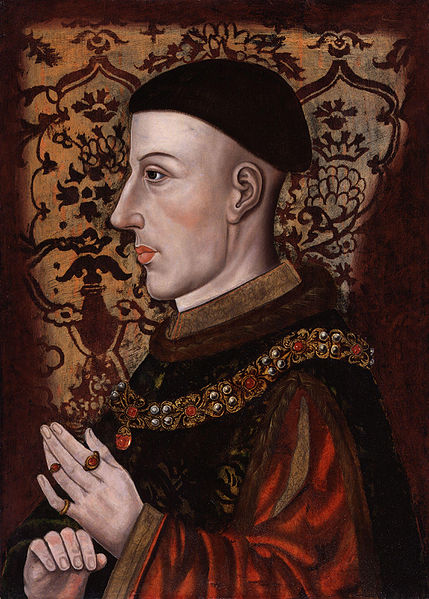
The past few weeks have been spent applying for my work visa to go to the UK for two years. The prospect of moving to England has me thrilled, chilled, and quilled. It is a terrifying prospect to go to a country where you know no one, but I think I will be fine. We'll see on how well my job search goes, I am hoping to work as some sort of historical guide. Oh, but that would be a dream! The paperwork has been a whirlwind of missing minuscule descriptions that seem rather innocuous. But alas, my paperwork has nothing on the paperwork following the death of King Henry V of England, and his baby son's immediate succession.

Henry V of England 
Born: c.1387 
Reign: 1413-1422
Death: August 31st, 1422


        Henry was born the first child of Henry of Boilingbrooke (later Henry IV) and his first wife, Mary de Bohun. Henry of Boilingbrooke was a descendant of the English Royal Family through his father, John of Gaunt (a son of Edward III) and Blanche of Lancaster. Given this, Henry IV never really expected to rule the kingdom. It was through the maltreatment of Henry of Boilingbrooke that lead to the takeover of the English crown by the House of Lancaster.

Henry had shown an aptitude and capability for managing government and military affairs. He was taught well by his caretakers, and included in a treasonous uprising in Wales (which as the Prince of Wales, he was required to help put down in order to save his inheritance). He became something of a hero and known for his valor and bravery at the Battle of Shrewsbury in 1403, whereupon when he was hit in the face with an arrow, he remained on the battlefield. Also, a lot of the funding for military campaigns came from his own estate revenues, which endeared him further to the Parliament. During these campaigns as Prince, he learned much about military tactics, which would help him in the future as King.

From 1406-1411, he became very influential in the King's Council (a body of advisers), however, his own opinion often differed very greatly from his father's, especially in foreign affairs. His father dismissed him from this post in 1411, though the Parliament still favoured him.

There was a slight change in the political atmosphere at court, whereby some of Henry IV's old enemies were growing tired of him, and sought to change that. Luckily, before anything happened, Henry IV died and Henry V succeeded him.

To be continued....

Wednesday, July 28, 2010

Love and the Marriage, it’s an institute you can’t disparage

This post is not going to go with the flow of my usual blog postings, but yet, I find this to be a long time coming post.

The History of Marriage

The history of marriage has been a long and complicated one. The history of Christian marriage is less long, but still complicated. It was never black and white. Christian marriage was only begun to be developed in the early 11th century.

For a long time, Christians could not marry within 5 degrees of affinity. Meaning that if they were 5th cousins, they were ineligible to marry each other. How were the many nobles able to marry? They simply applied for dispensations from the Pope, which were usually granted. In the case of the Spanish Hapsburg family, there were few marriages between double first cousins, first cousins, uncle and nieces, not allowed within the Christian marriage, but yet, ultimately allowed.
It is hard to believe that many peasants that lived in rural villages would be bothered to make sure that their spouses would not be within five degrees of affinity. Given that most people rarely ventured far out of their village, conclusions could be drawn that many married within their own communities and families. Today, the Catholic Church does not prohibit marriage between distant cousins, and I know of a few people personally that are products of 1st and 2nd cousins.
Henry VIII also used the degree of affinity to annul his marriage to Catherine of Aragon (his brother’s widow). His excuse was that the papal dispensation that was granted to Catherine and Henry was not the word of God.
Translation: It was not the word of God, because it did not suit my selfish needs. It was Henry’s desire for a male heir, and Anne Boleyn that caused the detachment from Henry and Rome. Henry changed the definition of marriage, by marrying his former mistresses’ sister (also not accepted using degree of affinity). Pope refused to grant the annulment, so Henry broke with the Church completely, and thus the Church of England (and new marriage definitions were born).
So the five degrees of affinity was a decent idea (though genetics weren’t known then), but completely impractical.
And many Christians, could not afford the privilege of weddings and officiants either. They could however afford to make solemn promises in the presence of two witnesses that they should be married.In the 15th-16th century, a betrothal and solemn promise was seen as the same as marriage, given that Henry VIII used Anne of Cleve’s pre-contract to the Duke of Lorraine’s son as a valid reason for their annulment. But the Bible differentiates between the betrothal and the marriage itself, but no distinction was made between these two in these centuries. (http://www.jewishencyclopedia.com/view.jsp?letter=M&artid=213).
According the Old Testament, the betrothal was a price paid by the groom for his bride, to the father. These later come in forms of bride prices and dowries (there are differences between the two) practiced by royalty and nobility to a great extent, and peasantry to a lesser extent. Peasant women may simply have a few dresses and some household items, while wealthier women would have many dresses, gold, jewels, etc.
Nowadays, do we accept bride prices? Or are dowries necessary for a Christian marriage? Perhaps in some cultures so, but not in most of “Christian” world (for lack of a better term, if someone has something better please inform me, and I am not making derisive commentary about the dowry system as a whole).  There may be some men that ask their future father in law for their permission to marry their daughter, but I have yet to hear of a man paying the bride’s father for her hand.
Dowries and bride prices: Not in today’s world. So that has changed.
The Old Testament also talks of bigamy (only men marrying multiple women), with the exception of some sects (some extreme Mormon sects and I don’t know of others, please let me know), it is not legal or even acceptable in most Christian divisions.
The New Testament says that one must be monogamous with one another, both the man and the wife. So Jesus changed the definition of marriage. It goes without saying that the idea of monogamy was flouted by the Christian world for several centuries henceforth. Many kings had mistresses, and flings, it was however, unacceptable for women to be adulterous.
Bigamy: Not in today’s world. So that has changed.
So basically, this post is a long winded explanation of saying that the Christian marriage has changed from it’s inception to today’s world. People’s ideas and sensibilities change all the time, so basically, deeming homosexual marriage unacceptable because it ruins Christian marriage is pure hogwash.
So dearest NOW (National Organization for Marriage), Concerned Women, Bigots, and the lot of you, you have no fucking clue what you are talking about.